
Global Operations Orchestration: Managing a Multi-Center GCC Portfolio at Scale
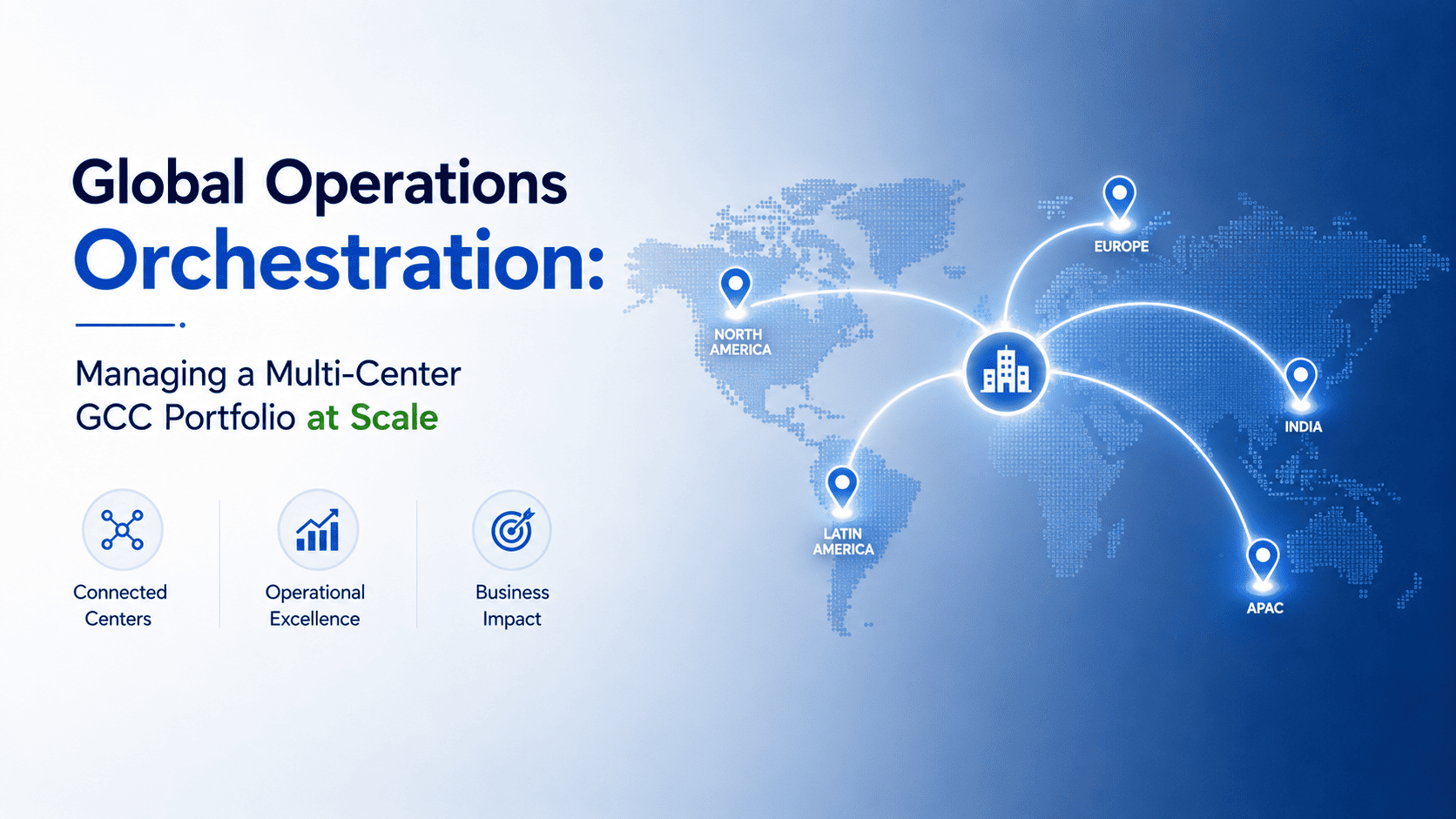
A single Global Capability Center is a management challenge. A portfolio of them, spread across regions, functions, and time zones, is a coordination problem of a different order. Each center tends to develop its own systems, its own governance habits, and its own version of the truth. The result is an enterprise that can see each location clearly but cannot manage them as a whole.
This article makes the case that the next stage of GCC management is global operations orchestration: coordinating strategy, execution, governance, and workforce across every center from one connected operating model. It looks at why portfolio complexity breaks traditional management, what orchestration actually involves, and how it extends across the full GCC lifecycle, including the growing role of GBS as an enterprise operating hub.
Why Managing Centers One at a Time Stops Working
The difficulty scales faster than the footprint. Two centers are not twice as hard to run as one, because now the enterprise also has to keep them consistent with each other. Add a third and a fourth, and the coordination load compounds.
Leaders running a multi-center portfolio consistently hit the same friction:
- Limited visibility across locations, so no one has the whole picture
- Operational data that does not connect from one center to the next
- Governance practices that drift apart as each site matures independently
- Decisions that stall while information is gathered from multiple teams
- Business performance that is hard to compare on a like-for-like basis
- Workforce planning that is done locally and rarely rolls up cleanly
Each of these is manageable at one site. Across a portfolio, they combine into slow decisions and rising operational risk.
What Is Global Operations Orchestration?
Global operations orchestration is an operating model that brings people, process, technology, and intelligence into one connected framework, so a portfolio of GCCs is managed as a coordinated system rather than a set of independent sites.
The word orchestration is deliberate. An orchestra is many players producing one coherent output because they share a score and a conductor. Orchestration gives a GCC portfolio the same thing: a shared operating model and a central point of visibility, without forcing every center into rigid uniformity.
In practice, orchestration lets leaders:
- Monitor performance across all locations in real time
- Standardize governance while allowing for local nuance
- Improve collaboration between distributed teams
- Keep operations aligned to enterprise strategy as conditions change
- Respond to market shifts across the portfolio rather than site by site
How Aokah Makes Orchestration Work
Coordinating a portfolio requires connecting the intelligence that each center generates. Aokah’s platform brings the core layers together into one decision environment:
- Workforce intelligence
- Location intelligence
- Governance insight
- Execution intelligence
- Operational analytics
- Business performance
Because these run on one connected fabric, leaders get a portfolio-level view rather than a stack of per-center reports, which is what makes coordinated management possible in the first place.
Standardizing governance across every center
Governance is the first thing to fragment as a portfolio grows. Aokah lets enterprises standardize policy, monitor compliance, and track performance across every center from one place, so accountability and operating standards hold regardless of location, while still leaving room for legitimate local variation.
Turning execution into a continuous practice
Quarterly reviews are too slow for a distributed portfolio. Continuous execution intelligence keeps projects, workforce performance, governance, and outcomes visible in real time, so the enterprise adjusts as conditions move rather than discovering problems a quarter late.
Orchestrating the Full GCC Lifecycle
Orchestration is not only about running centers that already exist. It spans the entire GCC lifecycle: strategic planning, business case, site selection, workforce planning, governance, performance monitoring, and expansion. Managing all of this on one connected platform removes the sprawl of disconnected tools and repeated consulting engagements that usually accumulate as a portfolio grows.
This is where Aokah’s products map to the lifecycle. Explorer supports the design and decision stages, Builder supports setup and build, and Optimizer supports ongoing optimization, so orchestration is continuous rather than a series of hand-offs.
Where GBS Fits: From Shared Services to Enterprise Operating Hub
Many enterprises run their GCC portfolio alongside a Global Business Services organization, and orchestration is where the two come together. A well-designed GBS operating model already concentrates process knowledge, enterprise data, standardized workflows, and cross-functional visibility. Those are precisely the ingredients orchestration depends on.
That positions GBS to become more than a delivery engine. With the right operating model and a connected orchestration layer, a GBS organization can act as the enterprise hub that coordinates capability, governance, and increasingly AI-enabled work across the business, rather than delivering efficiency in a silo. Orchestration is what lets a GBS redesign move in that direction instead of simply consolidating cost.
Conclusion: Coordinate the System, Not Just the Sites
As GCC portfolios grow larger and more strategic, managing each center independently becomes the bottleneck. Global operations orchestration provides the visibility, standardization, and coordination to keep distributed teams aligned, execution current, and the whole portfolio pulling toward the same strategy.
By combining decision intelligence, governance, and execution intelligence in one platform, Aokah helps enterprises orchestrate every stage of the GCC and GBS lifecycle with clarity and control, so leaders can focus on growth rather than on holding disconnected operations together.
Frequently Asked Questions
It is an operating model that coordinates workforce, governance, execution, and performance across a portfolio of Global Capability Centers from one connected platform, so the centers are managed as a system rather than independently.
Coordination cost compounds with each center. Orchestration standardizes governance, connects operational data, and provides portfolio-level visibility, which keeps decisions fast and consistent as the footprint grows.
Yes. A connected orchestration platform is designed to oversee multiple centers at once, supporting planning, governance, execution, workforce management, and continuous optimization from a single environment.
A Global Business Services organization already concentrates process knowledge, data, and cross-functional visibility. An orchestration layer lets GBS act as an enterprise operating hub that coordinates capability and governance across the business, rather than delivering efficiency in isolation.